• About Us
  • Our Interventions
  • NEWS & STORIES
  • عربي
  • About Us
  • Our Interventions
  • NEWS & STORIES
  • عربي
QF Alumni Community | QF Alumni Community Blog
BLOGS
Education and Its Role in Innovation in the Fourth Industrial Revolution
November 16, 2025

By Dr. Husam Arman, QF Alumnus
Research Specialist at the Kuwait Institute for Scientific Research (KISR)

Copy link Share on Facebook Share on LinkedIn Share on X

By Dr. Husam Arman, QF Alumnus
Research Specialist at the Kuwait Institute for Scientific Research (KISR)

Copy link Share on Facebook Share on LinkedIn Share on X
Education and the National Innovation System
Investing in education is a key driver of sustainable economic and social development. It has long been a top priority for senior decision-makers in official institutions because of its central role in development. Economists consider education one of the core foundations for building strong human capital capable of contributing to economic growth (1). The emphasis here is on the quality of education and the skills it develops, rather than simply the quantity of education.
Therefore, education must be viewed as part of a broader ecosystem in which the roles of government institutions and industrial companies intersect, forming what is known as the national innovation system. Before exploring this model, we first need to define “innovation” and its relationship to “creativity.” Creativity is a concept closely linked to innovation, but the two are often confused, especially in Arabic. In simple terms, creativity is the generation of a new and useful idea, while innovation is the implementation of such ideas, whether in technological or non-technological fields. The technological dimension includes products and the production process, whereas the non-technological dimension relates to marketing and institutional management. Innovation does not emerge in a vacuum, nor is it confined to industrial companies; it requires a comprehensive ecosystem that brings together academic, research, and industrial institutions, alongside government entities.

This year, the Nobel Prize in economics was awarded to Joel Mokyr, Philippe Aghion, and Peter Howitt, in recognition of their work showing the relationship between technological innovation and sustainable growth. This reflects the role of innovation in driving national development and in promoting economic and social progress.
Nevertheless, creativity remains the source of innovation, and thus, building the capacities of creative individuals is the foundation of innovation. This, in turn, requires an efficient education system able to produce such individuals, regardless of the specific implementation mechanisms, which should remain flexible and dynamic.
Education in the Fourth Industrial Revolution
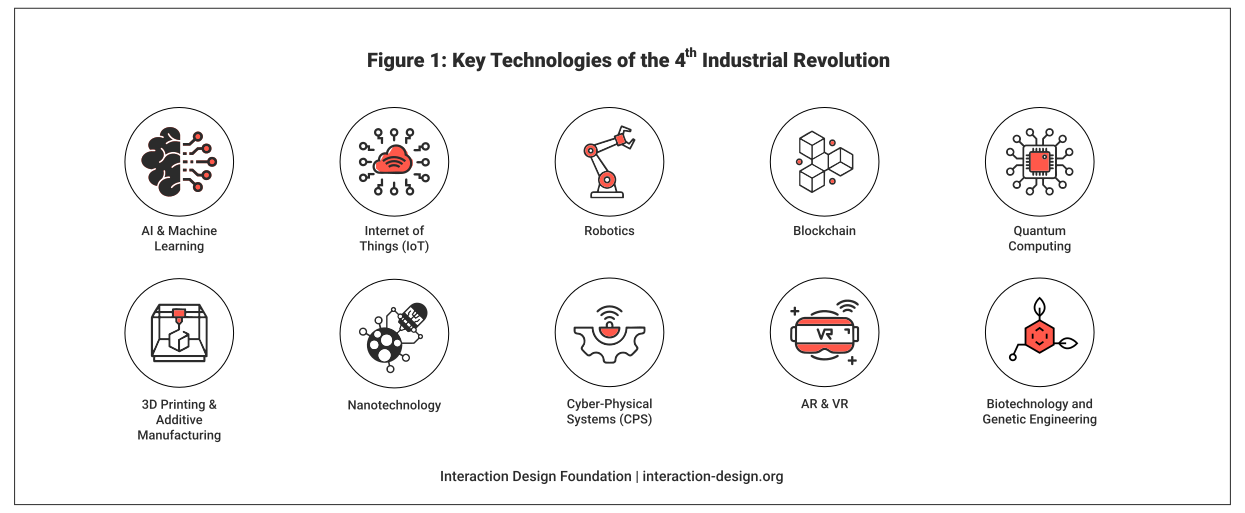
At the beginning of the twentieth century, public education was essential to meet the growing demand for labor needed to achieve high productivity rates. However, with major technological advances and the advent of the Fourth Industrial Revolution, marked by the spread of robotics, artificial intelligence (AI), 3D printing, and the Internet of Things (IoT) (see Figure 1), jobs and skills are undergoing radical change.
Therefore, the education system, especially higher education, must be revamped to respond to the future needs of an economic and social ecosystem that is completely different from previous models. Amidst these changes, jobs and wages will be affected, particularly routine jobs that lack creativity and innovation and are usually associated with so-called “blue-collar workers.”
According to McKinsey, 30% of labor hours will be automated by AI by 2030. As a result, companies will need to upskill their employees (2). The COVID-19 pandemic has also accelerated the adoption of technology and digital transformation in many countries, in both the private and public sectors, including those that had previously resisted such changes (3).
Hence, education systems should focus their outcomes on skills that add creative and human value, complementing the tasks carried out by AI and other automation tools in the future, a future that has, in fact, arrived earlier than expected.
Current education systems are facing growing criticism for failing to equip students with practical skills that match labor market needs. This is highlighted by Bryan Caplan in his book “The Case Against Education: Why the Education System Is a Waste of Time and Money”, where he stresses the importance of focusing on the quality and relevance of educational outcomes. Caplan argues that students spend many years studying large amounts of material that is unrelated to their future jobs and offers little benefit to their professional careers.

In such a system, university degrees mainly serve as a signal to employers that graduates are disciplined, committed, and can be trusted. Therefore, building an ecosystem that supports lifelong learning for all, through both physical and digital channels, is essential to preparing society to thrive in an increasingly dynamic and complex future.
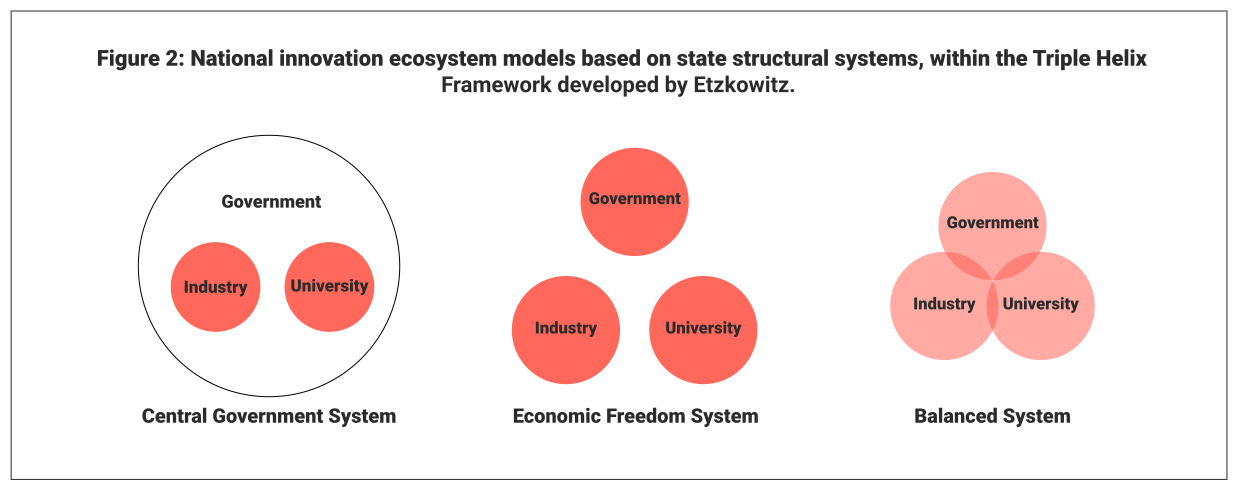
Therefore, educational institutions must focus primarily on building human capital by graduating creative and innovative individuals who can add value to the companies and institutions where they work, to their own businesses, or to any active player within the national innovation system, which includes academic, research, and government institutions (see Figure 2). Viewing education as an integral part of the national innovation system will maximize its impact and ensure greater alignment and synergy among the key actors within this ecosystem (4).
In my recent study conducted in cooperation with a team of researchers and colleagues in Palestine, we showed the weak alignment among institutions within the national innovation system and its negative impact on the ability of industrial firms to innovate (5). However, education systems, despite their seemingly intangible role in innovation, play a major coordinating role and have a positive effect on improving the relationship between industry and government. Hence, it is crucial to align the active players in the national innovation system and to orchestrate efforts to improve its performance and outcomes.
Universities must focus on graduating innovators and scholars, in addition to generating scientific knowledge that industry can commercialize, supported by state institutions. Successful countries have anchored their development plans on a clear science, technology, and innovation (STI) strategy. This model is evident in the experience of South Korea, Taiwan, and Singapore, where the national innovation system has played a central role in their success by supporting the pivotal role of education, despite differences in their economic structures and approaches (6). A recent study conducted in Kuwait, in cooperation with the London School of Economics (LSE), reached the same conclusion and recommended prioritizing education system reform (7).
The Fourth Education Revolution
The internet has contributed to the spread of Massive Open Online Courses (MOOCs), which are now offered by some of the world’s most distinguished professors, either free of charge or at very low cost. As a result, traditional universities are likely to be significantly affected by these models, especially given the rising cost of higher education, a trend that Harvard professor Clayton Christensen predicted twenty years ago.
The new generation of students and learners does not prefer the traditional formal classroom. A revolution is therefore needed to transform both the aims and methods of education. The educational process must focus on producing creative, emotionally intelligent graduates, because innovation and emotional intelligence will be the key “survival skills” in the Fourth Industrial Revolution. As Jack Ma, founder of Alibaba Group, has said, “We cannot teach our kids to compete with machines.”
Discussions are still ongoing among academics about the role of AI in education, its future, and what education systems need to do to equip learners with the skills required in both the short and long terms. Therefore, there is a need for a social innovation framework (8) and a parallel revolution in education (9), described by Seldon and Abidoye as “the Fourth Education Revolution,” in which the current traditional teaching model, where the lecturer controls the choice of topics and the learning environment, will not be suitable anymore.
Therefore, the focus should be on developing innovative curricula in teaching and learning that equip students with the practical skills required, especially those related to digitization and the Fourth Industrial Revolution. These technical skills must be complemented by behavioral and social skills that will give graduates an advantage in a future world where machines may outperform humans. Such skills include creativity, problem-solving, empathy, and collaboration.
It appears that cooperation between humans and machines is the most effective scenario, creating new dynamics of integration and value creation between the two, even in advanced cognitive domains, such as tasks that require creativity (10).
Accordingly, advanced and innovative educational methodologies must be adopted to help address these challenges, the most important of which is project- or problem-based learning  (PBL), an integral part of academic programs. Such projects are designed to enable learners to gain practical experience in working together to solve problems, while the educator’s role is largely limited to mentoring and guidance.
My Experience in Education and Innovation
I have always had a passion for learning, education, and communicating with others to spread science and knowledge. During my studies in Palestine, I enjoyed sharing what I learned with my colleagues. However, I never imagined I would have the opportunity to complete higher education. Despite all the challenges, and after obtaining a bachelor’s degree in Industrial Engineering from An-Najah National University in Palestine, I succeeded in obtaining a scholarship from the Qaddumi Foundation to pursue a master’s degree at the University of Nottingham in Operations Management and Manufacturing Systems. Afterwards, I was awarded a PhD scholarship at the same university, where I worked with Rolls-Royce to develop methodologies for monitoring and assessing relevant technological advancements.
I continued working with Rolls-Royce and other advanced industrial companies in the field of technology management and innovation, and I also taught at Nottingham Trent University.
Afterwards, I returned to Palestine and worked at An-Najah National University. During this period, I conducted several studies on the development and adoption of advanced, innovative teaching methodologies. I also worked as an academic assistant at the Centre for Learning and Teaching and was part of its establishment, alongside a group of distinguished academics, in cooperation with Northwestern University in the United States.
After moving to work at the Kuwait Institute for Scientific Research in Kuwait, my interests shifted to studying innovation at the national level, rather than only within individual institutions and companies. I implemented several projects in this field, in addition to joint research projects on education and innovation in Palestine and Jordan.

Throughout my academic and research journey, and through my volunteering with organizations concerned with innovation and education, I have had many opportunities to closely examine the experiences of small and medium-sized countries that have managed to advance by investing in education and innovation. Earlier this year, I joined a delegation from the Qaddumi Foundation on a study tour, during which we explored the Estonian model in this area.

We can build on the deeply rooted Palestinian culture of valuing education and achieve a great deal, just as many countries, such as the Asian Tigers, have achieved significant economic leaps by designing effective national innovation systems in which educational institutions play a central role in economic development planning based on science, technology, and innovation.

The Future of Education in Palestine

Rapid social and technological changes are having a profound impact on all sectors, including education, and especially on access to affordable higher education. Therefore, there is a need to rethink the education system in Palestine as an integral part of the national innovation system, one that can address the skills gap and strengthen the relationship between industry and academia.

We can build on the deeply rooted Palestinian culture of valuing education and achieve a great deal, just as many countries, such as the Asian Tigers, have achieved significant economic leaps by designing effective national innovation systems in which educational institutions play a central role in economic development planning based on science, technology, and innovation.
Hence, a national innovation strategy must be developed as a key lever for development, responding to the needs of Palestinian society and addressing the challenges it faces, including the constraints imposed on it. In this context, investment in digitization is an urgent necessity that can serve development goals, provided that these efforts form part of an integrated institutional initiative similar to the Estonian model.
On the education front, it is not enough to set broad directions and strategies; there must also be radical interventions and specific, detailed reforms related to teaching and learning. Innovative methods, such as practical project-based learning, can help achieve the desired outcomes.

Finally, the educational process must be designed with a high degree of flexibility, going beyond traditional classrooms to allow more room for blended learning and the use of technology in providing a tailored educational model that responds to the needs of individual learners.

References
  1. McMillan M, Rodrik D, Sepulveda C. Structural Change, Fundamentals and Growth: A Framework and Case Studies [Internet]. Cambridge, MA: National Bureau of Economic Research; 2017 May [cited 2025 Oct 22]. p. w23378. Report No.: w23378. Available from: http://www.nber.org/papers/w23378.pdf
  2. Hazan et al. The race to deploy generative AI and raise skills | McKinsey [Internet]. [cited 2025 Oct 14]. Available from: https://www.mckinsey.com/mgi/our-research/a-new-future-of-work-the-race-to-deploy-ai-and-raise-skills-in-europe-and-beyond#/
  3. Arman H, Al-Fulaij S, Al-Qudsi S, Alawadhi A, Al Ali M. COVID-19 effect on accelerating technology and innovation in businesses. Organizations and Markets in Emerging Economies. 2024;15(1 (30)):27–50.
  4. Mowery DC, Sampat BN. Universities in national innovation systems. In: 2009. p. 209–39.
  5. Morrar R, Arman H. The transformational role of a third actor within the Triple Helix Model – the case of Palestine. Innovation: The European Journal of Social Science Research. 2024 Apr 2;37(2):340–60.
  6. Arman H, Al-Qudsi S. A strategic framework to analyse the East Asian miracle within triple helix model–lessons for Kuwait. Journal of Science and Technology Policy Management. 2024;15(2):244–67.
  7. Arman H, Iammarino S, Ibarra-Olivo JE, Lee N. Systems of innovation, diversification, and the R&D trap: A case study of Kuwait. Science and Public Policy. 2022 Apr 16;49(2):179–90.
  8. Morrar R, Arman H, Mousa S. The Fourth Industrial Revolution (Industry 4.0): A Social Innovation Perspective. 2017;7(11).
  9. Arman H. Evolving Higher Education: Challenges and Opportunities on the Horizon. Journal of Modern Educational Research. 2023;2(13).
  10. Pedota M, Piscitello L. A new perspective on technology-driven creativity enhancement in the Fourth Industrial Revolution. Creativity and Innovation Management. 2022;31:109–22.

Sign up for our newsletter

Follow Us

  • Follow
  • Follow
  • Follow
  • Follow
  • Follow

Contact Us

+962 6 5817819

info@qaddumi.org

Address

Zahran Plaza Complex
Amman, Jordan
P O Box 2871,
Amman 11821 Jordan

qaddumi foundation

© All Rights Reserved 2023


Address

Zahran Plaza Complex
Amman, Jordan
P O Box 2871,
Amman 11821 Jordan

Contact Us

+962 6 5817819

info@qaddumi.org

follow Us

  • Follow
  • Follow
  • Follow
  • Follow
  • Follow

Sign up for our newsletter

qaddumi foundation

© All Rights Reserved 2023


Address

Zahran Plaza Complex
Amman, Jordan
P O Box 2871,
Amman 11821 Jordan

Contact Us

+962 6 5817819

info@qaddumi.org

Contact Us

  • Follow
  • Follow
  • Follow
  • Follow
  • Follow

Sign up for our newsletter

qaddumi foundation

© All Rights Reserved 2023